
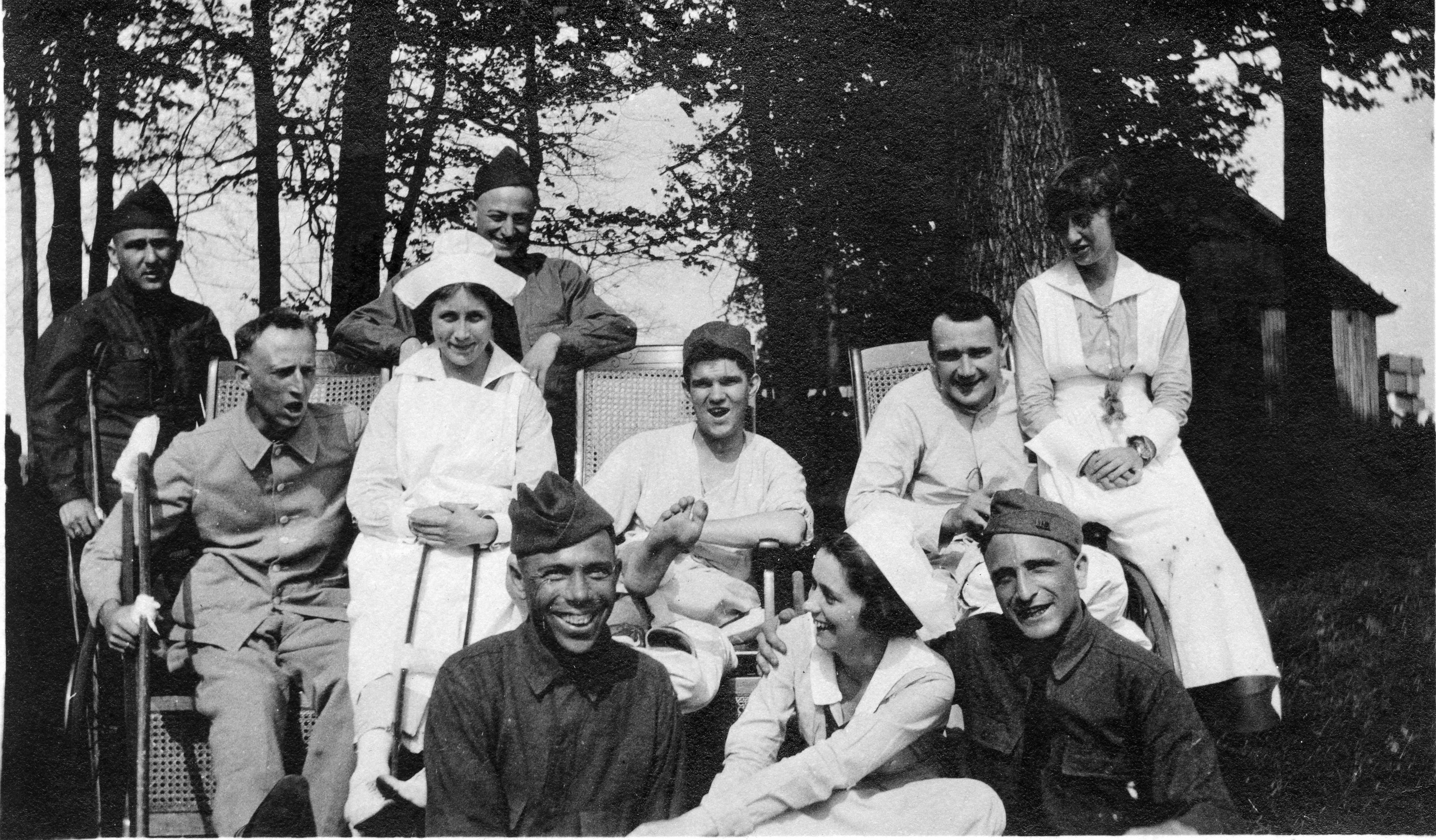
Charles Wing with Group at Camp Sherman
Description
This black-and-white photograph shows Charles Wing (seated in the front row, far right) in a group portrait with six other World War I soldiers and three nurses at Camp Sherman, Ohio. The group, comprised of white people who appear to be young to young middle-aged adults, is shown standing and seated outside with fully leaved trees in the background, so the picture was most likely taken in spring, summer or fall, 1919. The soldiers are dressed in military uniform, with two of them in hospital gowns, and three of the soldiers in wheelchairs. One soldier is standing with crutches and another holds a crutch while seated in a wheelchair. The nurses wear the Army nurse uniform.
Charles Dignan Wing was severely wounded on July 15, 1918, in the Battle of Aisne, Champagne-Marne, as a private in the American Expeditionary Force. He would have his right leg amputated, and spent much of the next few years in and out of hospitals. According to research by Dr. Stephanie Smith, he departed Europe on December 24, 1918, and was shipped back to the United States on the S.S. Powhatan. Wing was discharged from Camp Sherman on August 14, 1919. He was the recipient of a Purple Heart medal. Wing would go on to hold numerous official positions in Worthington over the course of 37 years--"an unparalleled career of service to the community," according to the Worthington News. Wing first became involved in civic affairs in 1925, when he was hired as the assistant village clerk. At various times during the following years he served as acting city manager, acting safety director, acting service director, acting health director, city clerk, chief deputy clerk, mayor’s clerk, and building inspector’s clerk. In 1942 Wing was named air raid warden for Sharon Township.
Camp Sherman was located near Chillicothe, Ohio. The U.S. entered World War I in April, 1917, and Camp Sherman was one of many camps that were hastily assembled in response. The Army constructed over 2000 buildings on the site in summer, 1917, and the first draftees began arriving in September. The influx of military personnel increased the population of Chillicothe from 16,000 to 60,000, and the camp earned the nickname “Ohio’s Soldier Factory.” Several African-American units, which were segregated at the time, were trained at Camp Sherman. Along with soldiers, the camp was occupied by volunteers and employees such as conscientious objectors and women who worked as nurses. Over 120,000 personnel would pass through the camp between 1917 and its decommissioning in 1921. Part of the land the camp was on has become the Hopewell Culture National Historical Park.
 In Copyright - Rights-holder(s) Unlocatable or Unidentifiable