
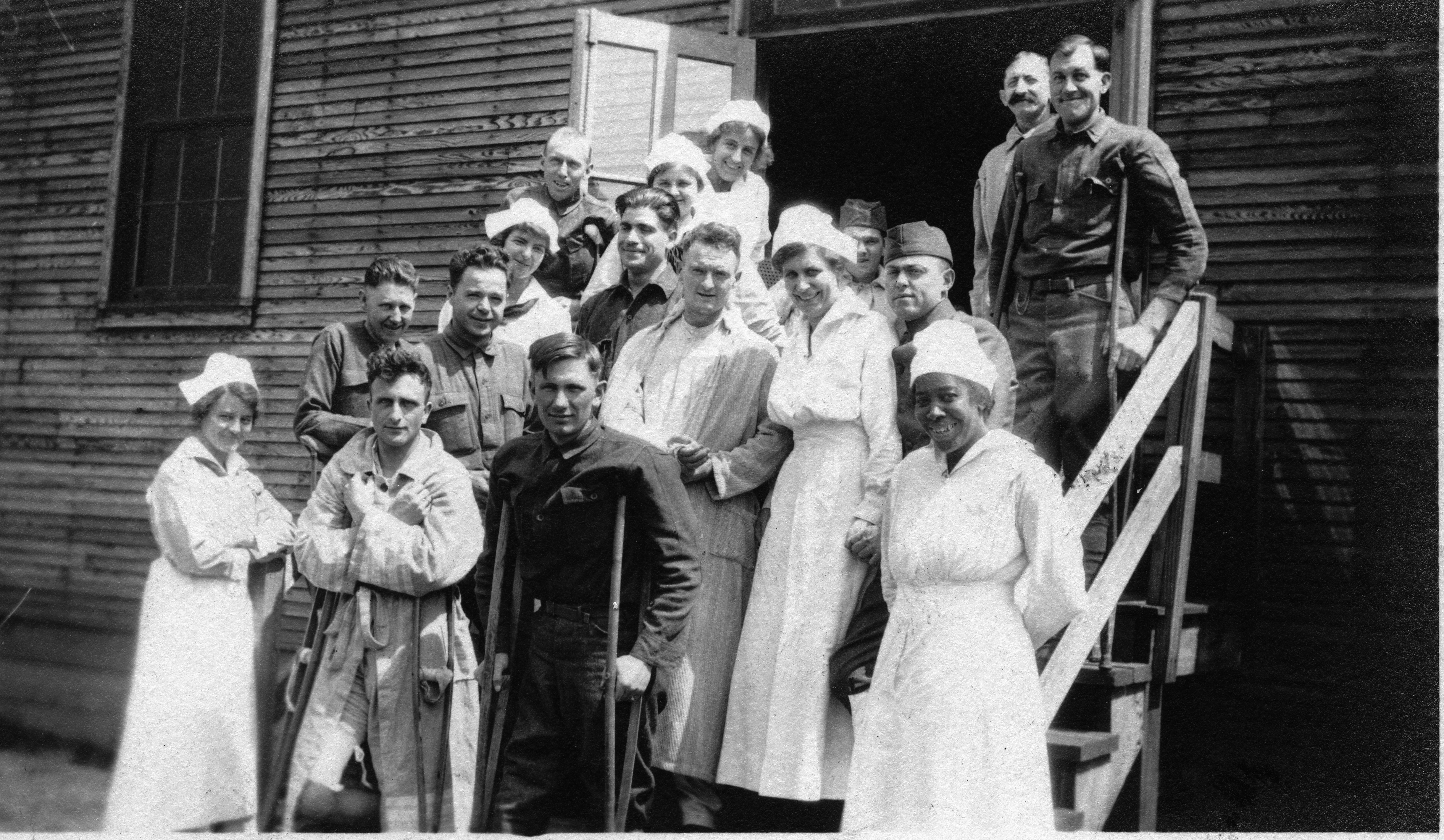
Charles Wing, Clara Rollins and Group of People at Camp Sherman
Description
This undated black and white photograph was taken at Camp Sherman, a huge military garrison near Chillicothe that was active from 1917 to a few years after the end of World War I. Charles Dignan Wing, the man in the robe who appears second from the left in the front row, spent the early months of 1919 recovering from severe war injuries there. He was discharged from Camp Sherman on August 14, 1919. Therefore, this photo would have been taken during the spring or summer of 1919, possibly by his future wife, Worthington resident Harriet Putman (Putnam). Wing and Putman married on July 7, 1920, in Trinity Episcopal Cathedral in Cleveland. They spent the rest of their married lives in Worthington.
The image also includes six nurses, recognizable by their white uniforms and caps, and other army, some of whom are on crutches.
Stephanie D. Smith at the University of Illinois Chicago has identified the Black nurse in the front row, far right as Clara A. Rollins. Eighteen Black nurses were initially mobilized to serve in the war effort, with nine serving at Camp Sherman and nine at Camp Grant in Illinois. Additional Black nurses were assigned to base hospitals at Camp Funston, Kansas; Camp Dodge, Iowa; Camp Taylor, Kentucky, and Camp Dix, New Jersey.
In June 1918, the Secretary of War announced its authorization of calling Black nurses into the national service, reversing an earlier decision not to accept them into the Army Nurse Corps due to no segregated quarters being available for them. By July 1918, tentative plans were made to send Black nurses in groups of 20 to several posts that had large numbers of Black troops. Delays in the provision of separate quarters and dining facilities resulted in their not being officially assigned to duty until after the armistice on November 11, 1918. (This history is shared in M. Elizabeth Carnegie’s, “The Path We Tread: Blacks in Nursing Worldwide”, 3rd Ed, Pgs. 168-169, Jones and Bartlett Publishers, Boston [2000].)
When the nurses arrived, they were assigned to segregated housing and warned by Chief Nurse Mary M. Roberts that "they should not expect to share in the social activities of the white nurses." Nevertheless, "Rollins became especially popular. Roberts later recalled that when she tried to move Rollins to a new ward, the patients in her old ward petitioned Roberts to request that she remain. 'They always called her 'the major' and the day before she left camp they had a special ceremony and made her a Lieutenant Colonel.'" (Roberts’ comments are published in "The Eighteen of 1918-1919: Black Nurses and the Great Flu Pandemic in the United States," by Marian Moser Jones, PhD, MPH, and Matilda Saines, BSc, American Journal of Public Health, June 2019, Vol. 109, No.6.)
It’s likely that Rollins’ service overlapped the flu epidemic at Camp Sherman. In the period between September 24, 1918 and November 19, 1918, 13,161 people were admitted for influenza and pneumonia, with 1,101 dying of the diseases. The fatality rate for influenza and pneumonia was 10% and 51% percent, respectively.
The raging flu epidemic required also mobilization of Black nurses to Camp Sevier near Greenville, South Carolina, who served for a period of three weeks. As quoted in Carnegie’s “The Path We Tread: Blacks in Nursing Worldwide”, Sayres Louise Milliken, Chief Nurse at Camp Sevier, South Carolina, wrote…“At the peak of the influenza epidemic at Camp Sevier…it became necessary to employ locally… every nurse who could be secured…About 12 [Black nurses] reported for duty…These young women were found to be well-trained, quiet and dignified, and there was never at anytime evidence of friction.”
Rollins and her eight fellow Black nurses at Camp Sherman had graduated from a three-year nurse training course at the Freedmen’s Hospital in Washington, D.C., one of the very few programs open to Black physicians and nurses at the time. It's likely that she and other Black nurses in the Army Nurse Corps were demobilized around August, 1919.
 In Copyright