
Harriet Putman, Susan Boulding and Others at Camp Sherman
Description
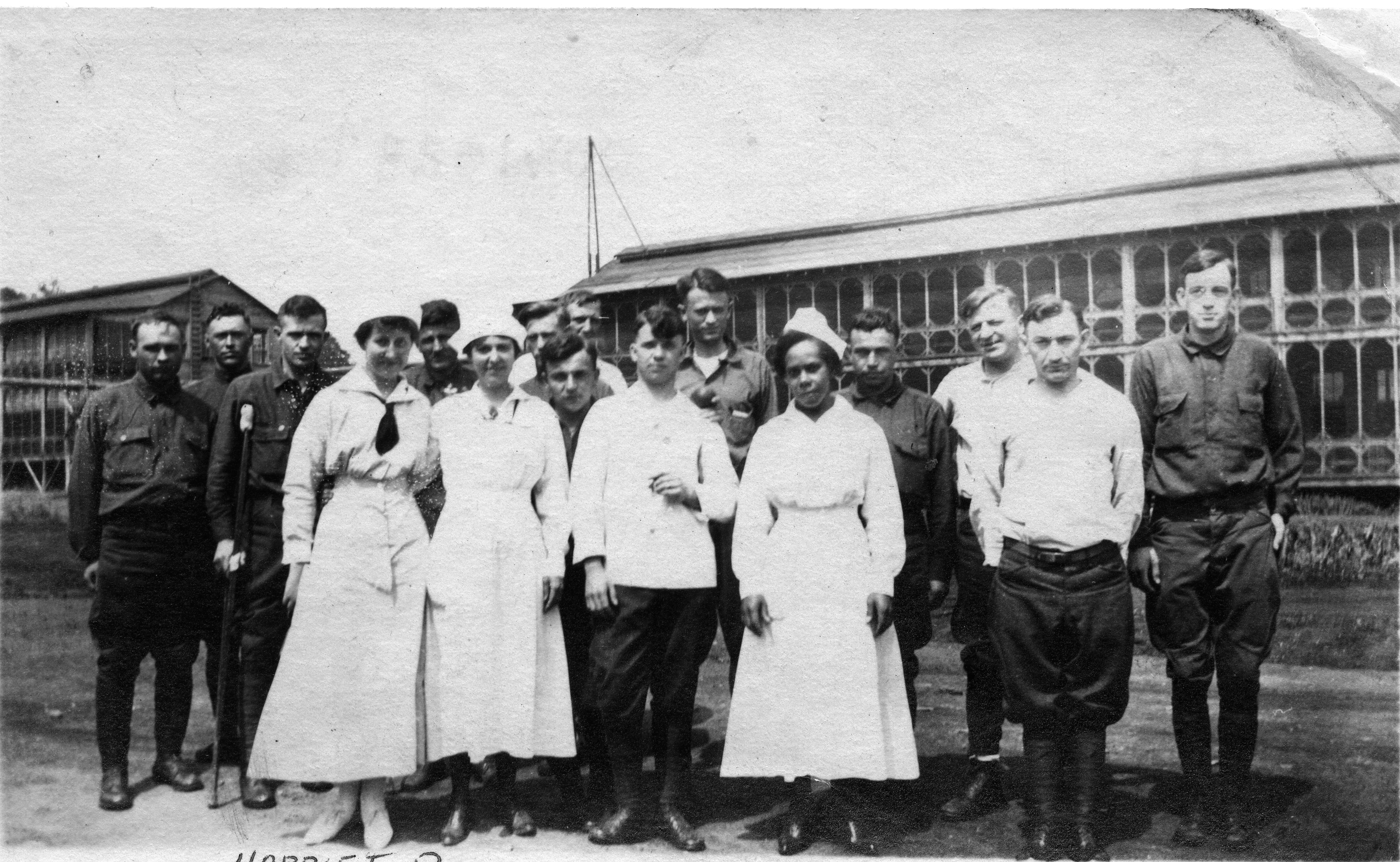
This undated black and white photograph of army nurses and their patients was taken at Camp Sherman, a huge military garrison near Chillicothe that was active from 1917 to a few years after the end of World War I. This photo would have been taken during the spring or summer of 1919. It includes three nurses, recognizable by their white uniforms, several men in white smocks that suggest they were medical aides, and soldiers in army uniforms. The group is positioned in front of what appears to be a two-story barrack with verandas. A second barrack can be seen at the far left.
The nurse in the white uniform, fourth from the left, is Harriet Putman (Putnam). She grew up in Worthington, and at Camp Sherman in 1919 met Charles Dignan Wing, a soldier whom she later married. Wing, who is not included in this photo, spent the early months of 1919 recovering from severe war injuries at the camp. Wing and Putman married on July 7, 1920, in Trinity Episcopal Cathedral in Cleveland. They spent the rest of their married lives in Worthington.
Stephanie D. Smith at the University of Illinois Chicago has identified the Black nurse, fifth from the right, as Susan M. Boulding. Boulding's inclusion is notable given the ingrained racial segregation practiced by the U.S. Army and the Red Cross at during this period. Boulding was one of nine Black nurses stationed at Camp Sherman.
Eighteen Black nurses were initially mobilized to serve in the war effort, with nine serving at Camp Sherman and nine at Camp Grant in Illinois. Additional Black nurses were assigned to base hospitals at Camp Funston, Kansas; Camp Dodge, Iowa; Camp Taylor, Kentucky, and Camp Dix, New Jersey.
In June 1918, the Secretary of War announced its authorization of calling Black nurses into the national service, reversing an earlier decision not to accept them into the Army Nurse Corps due to no segregated quarters being available for them. By July 1918, tentative plans were made to send Black nurses in groups of 20 to several posts that had large numbers of Black troops. Delays in the provision of separate quarters and dining facilities resulted in their not being officially assigned to duty until after the armistice on November 11, 1918. (This history is shared in M. Elizabeth Carnegie’s, “The Path We Tread: Blacks in Nursing Worldwide”, 3rd Ed, Pgs. 168-169, Jones and Bartlett Publishers, Boston [2000].)
When the nurses arrived at Camp Sherman, they were assigned to segregated housing and warned by Chief Nurse Mary M. Roberts that "they should not expect to share in the social activities of the white nurses."
Nevertheless, they were recognized by their contemporaries as leaders in the civil rights struggles of their time. In 1919, "The Crisis,” a publication of the National Association for the Advancement of Colored People (NAACP), received a photo of the Camp Sherman nurses sent by Mattie McGhee, the widow of civil rights pioneer Fredrick McGhee. An accompanying note stated: “These young women willingly responded to the call when the country needed them, some of them giving valiant service during the Flu Epidemic, under the American Red Cross. Having been assigned to military duty they have faced every difficulty and are winning many small battles for the race.”
It's likely that Boulding and other Black nurses in the Army Nurse Corps were demobilized around August, 1919.
 In Copyright